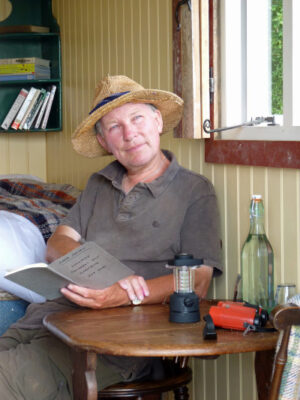

The last two summers have been remarkable for butterflies: two great summers on the trot, albeit after a shocker in 2024. Populations of most British butterflies soared – we know this because our butterflies are amongst the most closely-monitored creatures on earth. They are boom and bust creatures.
Butterfly monitoring started at Sapperton Wilder in 2024, using the tried and trusted ‘Butterfly Transect Method’, established in 1976. The data from three years of diligent recording here show that butterflies are thriving in the fields. The overall population has doubled in size two years running – not bad for fields that were in arable just 5 years ago.
Sapperton Wilder now supports sizeable populations of most meadowland butterflies – a group of insects which declined horrifically during the last 100 years, when 98% of traditional English meadows were lost. Sapperton Wilder, and other meadowland systems established under the Regenerative Farming banner, and stimulated by a Defra funding scheme promoting ‘herbal leys’, show that populations can bounce back. The Longhorn cattle grazing regime is clearly suiting the meadowland butterflies.
Commonest at Sapperton Wilder is the Meadow Brown, formerly a ubiquitous meadowland species whose larvae feed on grasses. Nearly 10,000 were recorded on transect in 2026, compared to 7,141 in 2025 and 3,639 in 2024. Other species whose larvae feed on grasses are also thriving – Marbled White, Gatekeeper, Small Heath and two species of skipper, Small and Essex.
Perhaps the most important species here, performing best, is the Common Blue. Now, this hasn’t been ‘common’ for several decades, outside of some managed nature sites, but is thriving at Sapperton and at many other sites in the Defra herbal ley scheme, breeding on Birds-foot Trefoil and various clovers. Sapperton Wilder’s meadows must now support one of the strongest populations of this jewel in Gloucestershire: 4,405 were recorded in 2026, up from 1,041 in 2025 and just 213 in 2024.
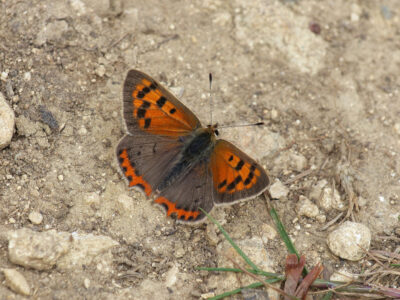
Also of note are small but increasing populations of Small Copper, formerly a ubiquitous meadowland species, breeding on various sorrels and docks, and a small population of the rather local Dingy Skipper.
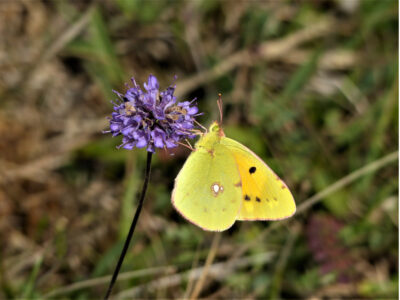
And as for a cherry on the cake, 2026 was one of the best years on record for the spectacular Clouded Yellow, which comes here in ultra-special summers from its Mediterranean heartland, producing UK-grown broods, breeding on lucerne, sainfoin, clovers and Birdsfoot Trefoil – all of which are present in the herbal leys. 89 were recorded at Sapperton Wilder this year.
There were some losers, of course, species such as the Ringlet and Speckled Wood which are creatures of shade – heavy shade in hot summers – and didn’t venture into the open fields. Large Skipper also fared poorly, as its emergence coincided with the summer’s only spell of poor weather (the first eleven days of June). Also, the two ‘Cabbage Whites’ subsided this year, after booming in 2025 – probably because of parasite catch-up: their larvae are heavily parasitised by tiny wasps, the wasps took a big hit in the wet summer of 2024 allowing the host to jump ahead.
Now, if the butterflies are thriving here, so are a great many other warmth-loving insects and invertebrates.
Next year, though, is a business-critical year for butterfly monitoring, nationally: we will find out whether the heatwaves and drought of 2026 were too much for various larval foodplants, and/or the vulnerable egg and young larval stages. We will find out!
Blog and photos by Matthew Oates
Matthew Oates is a naturalist with an arts background and an interest in the poetic approach to nature. He retired in 2018 from 30 years as the National Trust’s adviser on nature conservation. A specialist on butterflies, other insects, grazing ecology and people’s relationships with nature, he is the author of several books, including In Pursuit of Butterflies (2015) and His Imperial Majesty, a natural history of the purple emperor (2020), and Beyond Spring (2017). Matthew helped set up butterfly monitoring at Sapperton Wilder and provides invaluable expertise to the project as a whole. Matthew also helps with the rewilding enterprise at Knepp Castle Estate in West Sussex.